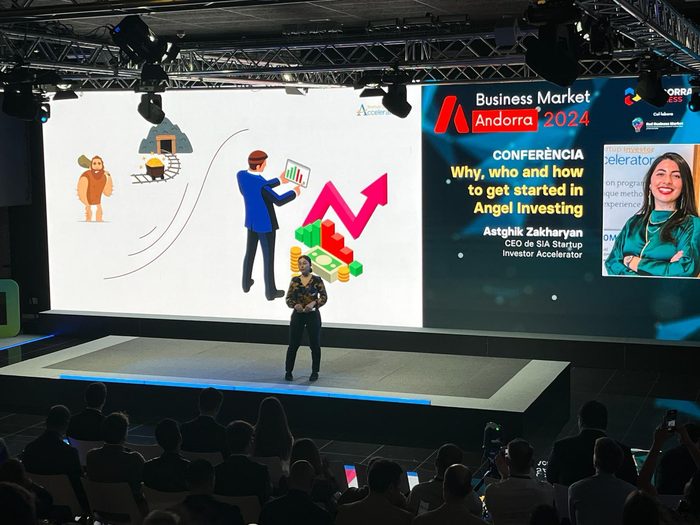
Angel investing has historically delivered average annual returns around 27%, with successful portfolios often reaching 3x multiples — yet most qualified professionals who could participate never do, not for lack of money, but for lack of a structured way in. That was the case I made at the Andorra Business Market keynote: the biggest barrier isn't credentials or capital, it's simply not knowing the door is open.
Why it's worth doing at all. Beyond the returns, what I find people underestimate is the second and third-order value. Evaluating pitches and sitting with founders through their hardest decisions is some of the fastest continuous learning available to a working professional, and at a regional level, active angel syndicates are genuinely a multiplier — they pull talent, capital, and follow-on investment into local ecosystems that would otherwise lose their best founders to bigger hubs.
Who actually does this well. The myth is that you need a finance degree or an engineering background. In practice, the domain experts I've watched add the most value in due diligence are often the least "typical" — an aviation specialist spotting a real safety flaw in an aerospace pitch, a chef evaluating whether a food-tech claim actually holds up in a commercial kitchen. Regulatory frameworks in most jurisdictions exist to protect retail investors, not to lock qualified professionals out. The real barrier, every time I've seen someone hesitate, is a lack of awareness of how to get structured access to deal flow — not a lack of capital.
How to actually start. Three things, in order: define your thesis before you write a single check — are you here for financial return, for exposure to deep tech, or for impact, because that answer changes every decision after it. Then size your commitment realistically: a resilient portfolio needs diversification across 20 or more startups, because early-stage mortality rates mean you're underwriting a power-law outcome, not a sure thing. And don't try to learn this from the sidelines — join a cohort, sit through real diligence on a real deal, and expect to spend 20–40 hours in diligence per investment once you're serious. That last number isn't arbitrary; it's roughly what the Angel Capital Association's own benchmarks correlate with stronger portfolio outcomes.
From the Andorra Business Market 2024 keynote. Watch it here → Want to go deeper? Book an advisory call — or see what else SIA Angel Hub is building.