The end of near-zero interest rates didn't just make capital more expensive — it rewrote what "good" looks like at the growth stage. During the 2020–2021 boom, late-stage companies routinely raised at 30x–50x forward ARR. That multiple has compressed by 60–80% since, and the reason is almost mechanical: as the risk-adjusted discount rate rises, future cash flows get penalized harder, and unprofitable growth stops being fundable on promise alone.
| 2021 Hyper-Growth Benchmark | 2026 Resilience Benchmark | |
|---|---|---|
| Valuation Multiple | 25x–50x ARR | 6x–12x ARR |
| Burn Multiple | Above 2.0x (burning $2 to make $1 ARR) | Under 0.8x (capital-efficient growth) |
| Runway Target | 12–18 months | 24–36 months / cash-flow breakeven |
| Board Priority | Market share & GMV capture | Gross margin & EBITDA protection |
Clickalia is the sharpest example we discussed of what surviving that shift actually looks like in practice: a company that stayed profitable and cash-flow positive straight through COVID, with a 0% layoff rate post-pandemic — not because it avoided hard decisions, but because it had engineered EBITDA positivity into its model early enough that it never needed a bridge round to survive a shock.
On the AI side, SoftBank Vision Fund's own portfolio — over $140B deployed across both funds, 470+ AI-enabled companies — offered a useful corrective to the more speculative AI narrative dominating most conference stages this year. Institutional investors aren't evaluating AI adoption as novelty; they're evaluating it as three concrete tiers of operational leverage: conversational automation that cuts customer acquisition payback periods, predictive pricing and automated underwriting (the core of how PropTech platforms like Clickalia can make instant cash offers without a human underwriter in the loop), and full workflow modularization — breaking monolithic operations into interconnected systems that keep legal, mortgage, and logistics processes synchronized under one architecture.
The governance point is the one I'd underline for any founder taking growth-stage capital right now: the investor-founder relationship at this stage isn't passive board oversight. It's global network access for cross-border expansion, continuous stress-testing of runway and net retention, and — the part that's easy to skip in a slide deck — supporting a management team through a downturn without resorting to layoffs that cost you the institutional knowledge you spent years building.
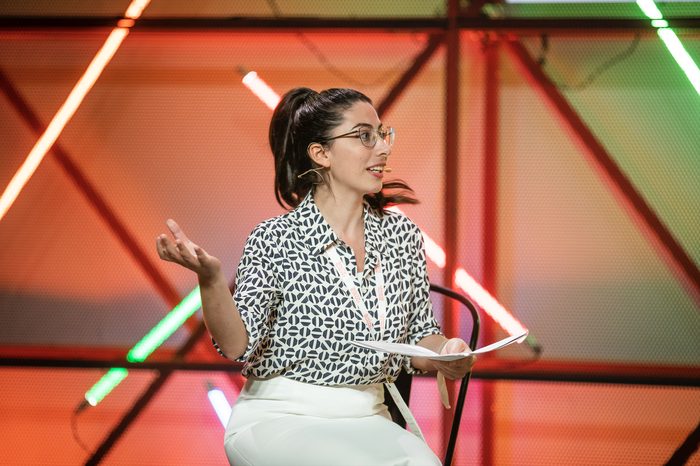
On stage: Nahoko Hoshino, Director of Investments at SoftBank Vision Fund, and Alister Moreno, founder of Clickalia.
From the South Summit Masterclass on VC Resilience & AI Integration. Watch it here → Taking on growth-stage capital yourself? Book time to think it through, or read more about SIA Angel Hub.